Friday, 30 March 2012

The Forbidden Gate (Knightmare gamebook 5) by Dave Morris

Once again, Ill be reviewing a gamebook based on an existing franchise.  This time, it is The Forbidden gate, the fifth gamebook based on the Knightmare TV series.  There are six gamebooks and one puzzle book in the Knightmare series.  Dave Morris wrote first one jointly with Tim Child (the creator of the Knightmare TV show) and then wrote the remaining books alone.  The gamebooks (not the puzzle book) are all preceded by a novella about Treguard's adventures which are also very entertaining.

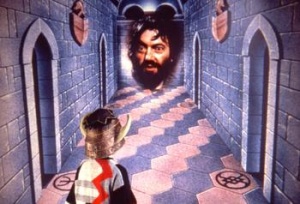
For those of you who don't know about the Knightmare TV show here is the concept:  A team of four children are pitted against a dungeon full of monsters, traps and strange characters.  One of them is the 'dungeoneer' who has to survive the dungeon while wearing a huge horned helmet that obscures their view (this is so that they do not see the blue screens used for the effects backdrop).  The dungeoneer's friends guide them through the dungeon.  Unlike many childrens' TV gameshows it was a very sophisticated game with a high failure rate but that made success all the more sweeter.
It is interesting to read the gamebooks in chronological order as they gradually move away from the format of the TV show where you have to find your way through a three level dungeon to a more open setting where you travel across the land and interact more with people.  I guess that one issue with transferring the format of a TV show to the format of a gamebook means that things will get lost in translation and things that work for TV don't work in the gamebook (thankfully, in the gamebook your vision is not obscured by the helmet of justice.  That would make for boring reading similar to doing the Colossal Cave with no brass lantern).

Anyway, on to the review...


Theme 3/5


The aim of the gamebook is to steal an earth dragon's egg from right under its nose.  Now that's a dangerous task and the reason why you have to go into a dragon's lair and steal its young is not clearly given.  Maybe Treguard wants to train one up for the Knightmare challenge.

However, as in all Knightmare gamebooks, it is the journey which is important and not the destination.  You spend very little time on the dragon's island - most of your adventure involves getting passage on a ship and then surviving the journey.  The ways of succeeding the challenge involve acting as a true knight - with quick wits and chivalry.  So the dragon's egg is really some macguffin to prove to Treguard that you are worthy to be a knight.  It's a bit like the end of Midnight Rogue where the gem is a fake but by overcoming your trials, you have proven yourself to be part of the guild.

As Treguard says:

'The path to chivalry is long and arduous' he says 'Now you must prove yourself worthy.'
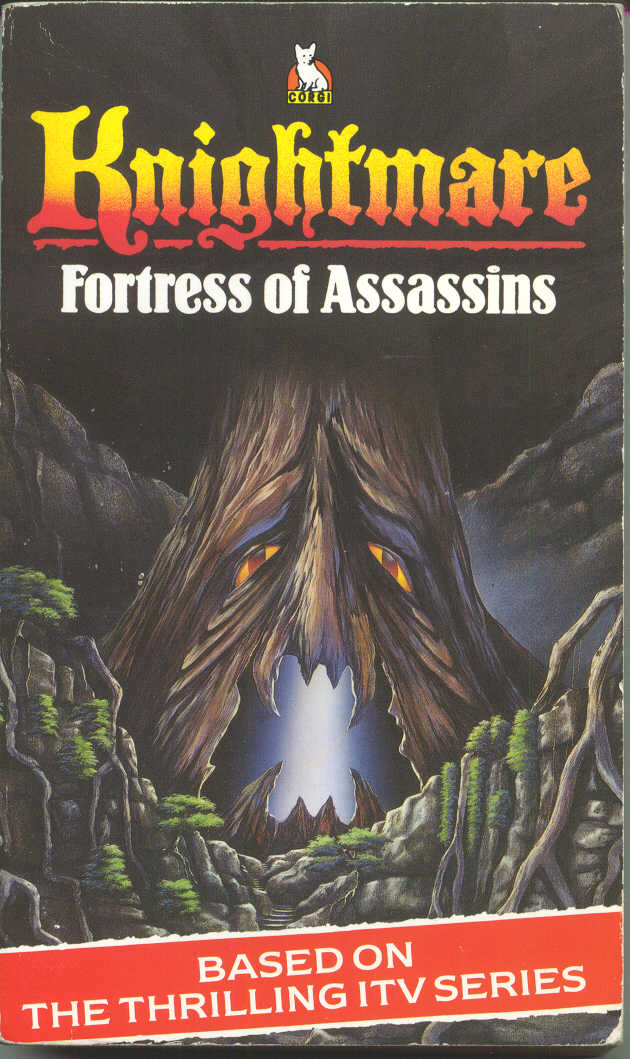
Illustration 2/5


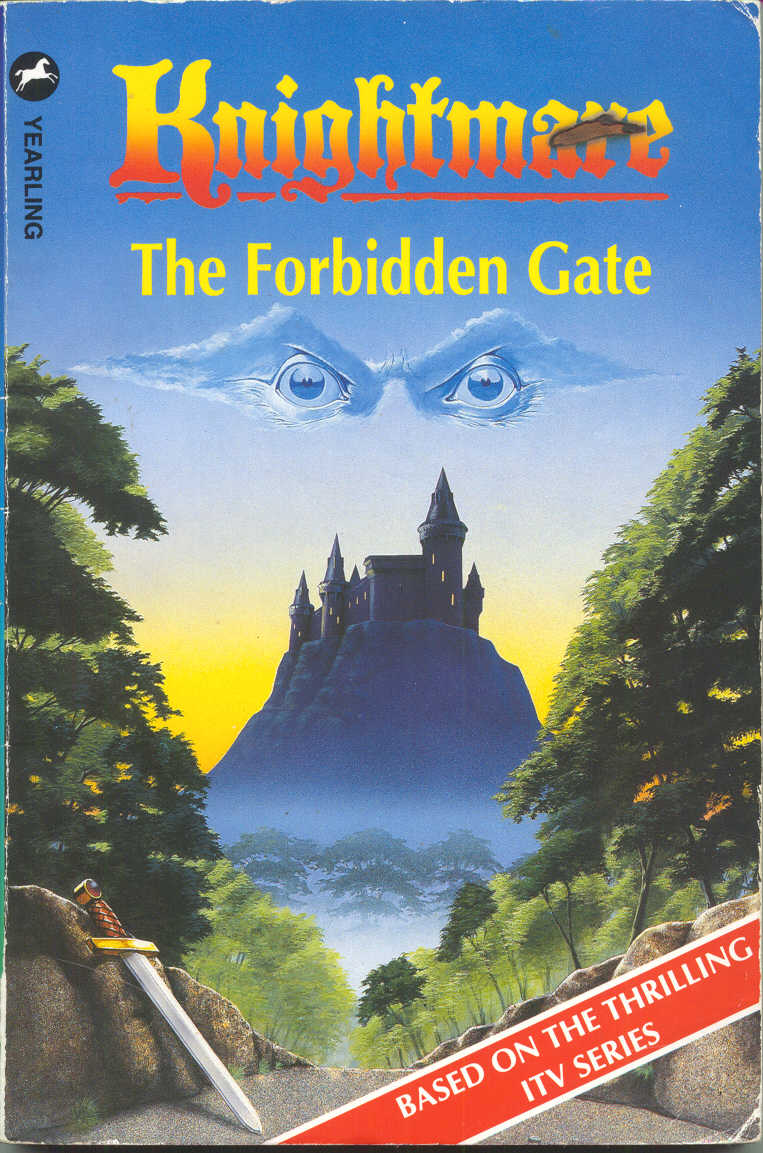
The cover illustration, intended for the novella shows a lovely forest with a castle on the top of a hill in the background and Lord Fear's eyes in the sky.  It is a nice picture, but I don't think that the colour scheme befits a Knightmare book (the previous ones all having black as the dominant colour).  It seems more suited to an elvish glade rather than a forbidden gate.  Even the menacing eyes don't seem that menacing as they are a lovely shade of azure and drawn like clouds.

The interior illustrations of the gamebook are all quite small and done well enough - there just aren't many of them.


Gameplay 4/5


Dave Morris demonstrates his skill in this area.  Despite being only 97 paragraphs, Morris manages to stretch it out by having the range of skills and having the player try to find the optimum path for your chosen skill.  Morris has also put situations in the book which could allow you to succeed very well.  for example, you can get an extra skill and a spell in the book if you do particularly well.  There is also a very clever ending situation where if you make the right choices (which appear to be the wrong choices at first), you are able to free some slaves in addition to stealing the dragon's egg, giving the player a kind of bonus ending to work for.

As in previous Knightmare gamebooks, Dave Morris also rewards the player for reading the novella before hand as it is a good idea to know the 'morality' of the gamebook.  There are certain ways of thinking that the gamebook encourages - for example, using weapons is rarely the best way out of a problem.

The tricks that Dave Morris uses do help make the most of a short 97 gamebook and even though it is still too short to get lots of play out of it, it certainly stretches it out and marks should be given for ingenuity.


Exposition 3/5


I have always found Dave Morris's writing very eloquent (sometimes too much so when writing the dialogue for a barbarian).  The world here is one of chivalry, sorcery and roguish opponents.  There are also moments for humour such as a golden malicious apple and the scene where you return to Knightmare Castle by accident to find Pickle and Treguard eating sandwiches and drinking coffee.  It is a good mix of evocative drama with a touch of light heartedness.


Rules 3/5


The rules are vaguely linked to the rules from the TV show.  Your health is measured in Life Force grades.  You start off unwounded with a green grade.  If you lose a grade, you go down to amber and if you lose antoher one, you go down to red.  If you are wounded while on red life force, you die.  You can restore life force by eating food on paragraphs marked with an *.  This makes the idea of resting to eat more realistic than Fighting Fantasy's rule of 'You can't eat when in combat.  You can eat when running, climbing, swimming, talking or falling but not when in combat.'

You are also able to learn spells.  When you are given the chance, you are given the name of the spell which may or may not be self explanatory.  Spells are not items and you may only use them once.

You may carry up to 5 items.  Dave Morris does something very clever with the encumbrance limit towards the end of the book.  If you get into the dragon's lair, you find two different varieties of eggs, but since they both count as 3 items, you may only take one egg.  Nice touch.  You may carry 50 gold pieces as one item.  You also have the choice of one skill to choose from the following list:  Acrobatics, Fisticuffs, Gambling, Seamanship, Swimming, Swordplay, Thievery, Trading.

Those of you who are familiar with the Virtual Reality series of gamebooks will find the last set of rules very familiar.  Indeed, it seems that this book (published in 1993) was a precursor to the Virtual Reality series (published in 1994).

The rules work well enough - however, the short length of the book makes the skills only useful in a few situations.  The only use of some skills is to obtain passage on a ship to the either by getting money or by making your skills useful to the captain of the ship.  However, as the Virtual Reality series has shown us, such a system is very good for longer gamebooks.


Total 15/25


The problem with all of the Knightmare gamebooks is that they are too short to showcase the skill that Dave Morris has.  The Quest for the Dragon's egg quest is the shortest Knightmare quest at only 97 paragraphs and it seems that Dave Morris put a lot of effort into making such a short gamebook replayable.

In tiger terms, is a decent snack. It seems that Dave Morris was given a very small piece of meat and told to make it palatable. He added plenty of other tasty stuff to bulk it out and cooked it as well as he could.  However, it is still a very small piece of meat so it won't satisfy for long.

One good thing about this book is that it may have been an important experiment for Dave Morris which may have led to the Virtual Reality series - this book certainly demonstrates that the game system is a good way of improving gameplay and increasing replayability.  It is a good reminder that gamebooks and other art forms should never be looked at in a vacuum but rather as a smaller part of a larger creative process.  The Forbidden gate did very well as a Virtual Reality precursor and it may have been the deciding factor in bringing us the series.

Saturday, 24 March 2012

Stormin' Sonic by Marc Gascoigne and Jonathan Green

It's a testament to the popularitiy of gamebooks in the 80s and 90s that eventually, companies started making spin off gamebooks of their products.  There were gamebooks based on boardgames, gamebooks based on toys, gamebooks based on TV shows, gamebooks based on comics and gamebooks based on computer games so since Sonic the Hedgehog was such an icon to children everywhere in the 90s that it was only a matter of time before he also got his own gamebook series.

There are six Sonic the Hedgehog books written by various authors.  Stormin' Sonic, the sixth and final book in the series was written by Jonathan Green and Marc Gascoigne.  I never played Sonic when I was a little 'un (cue tales of woe involving working twenty seven hours a day down pit) but I wanted to see what I had missed out on.

One interesting thought I had about this book and all gamebooks based on a tie in to an existing product is how much of it is dictated by the product's existing rules and story.  For example, did Jonathan and Marc have to make Robotnik the enemy, include characters from the game and base the game rules on rules from the computer game?  And do such things change a gamebook for the better or for the worse?  I would like to hear peoples' thoughts on this.

Theme 3/5


The weather on Miobius has gone nuts and you need to set it right.  The perpetrator is Robotnik (obviously) and you need to travel to different zones on the planet to collect clues in order to track down your arch enemy and stop him.  This plot invloves the theft of a chaos emerald and the inevitable appearance of Knuckles the echidna and the inexplicable kidnapping of Sally Acorn only to have her disappear just after she is rescued.  I'm sure a weather based story is almost inevitable in any long running adventure series or cartoon series (I'm talking about TV film and games, not just gamebooks) so it is not the most original of themes.  However, the four areas that Sonic and Tails explore are pretty fun with many opportunities for cool things to happen.


An interesting side note is that I think I'm starting to see how certain authors' ideas evolve.  The basic story of Stormin' Sonic is that a crazy individual has created a flying machine crewed by mechanical creatures in order to control the weather and take over large areas of land or even the entire world.  The hero has to explore four areas in order to obtain the means to defeat his opponent by getting on board his ship, defeating him in combat and then trying to excape from the ship before it is destroyed.  Does that remind you of any other gamebooks?

Illustration 2/5


 The many simple, cartoonish illustrations give me the impression that this book is aimed at younger readers; maybe pre-teens.  They are serviceable, pleasant to look at and do not have too many details.

Gameplay 2/5


After an introductory scene where Sonic finds out what is going on, we then move onto a hub where we choose one of four places to go. Once we have enough clues, we can then go on to save Sally Acorn and defeat Robotnik.  This then leads to the final scenario where we face Robotnik and his minions.  Most of the branches lead of to an area where you could get some rings and then return to the main path.  This makes the book quite linear as most of the choices revolve around how you will fight enemies as you will probably have to go to all of the locations anyway, your only choice is in which order you do so.  There is also an annoying section where if you have found Sally Acorn's scarf, you drop everything and end up in the final area without the option of exploring other places.  This caused me to lose my first play through, so I made sure that I went in another direction.

There are also a few occasions where Sonic will not let you take a certain course of action despite you choosing it.  These choices involve you being particularly cowardly.  If you choose them, Sonic will scold you and do the thing you didn't choose to do.  The idea behind this was probably to have someone kids look up to tell them how they should act and to make sure that they don't do naughty things like leave their best friend to roll down a mountain in a giant snowball or teleport back home before you have sorted out Robotnik.  The effectiveness of such a program of moral instruction has yet to be determined.

Who can resist the lure of the
mystery box?

One thing that I liked amongst the options was the occasional option to try 'something else' to overcome the problem.  Intrigued by this option, I had to choose the 'something else' option every time - the mystery box of gamebooks.  I was not disappointed, especially when the option involved Sonic and Tails putting on an ice skating display to impress some robotniks.


Exposition 3/5


The writing sees to be aimed at pre teens and the language takes me back to the 90s.  I'm sure that I would have enjoyed it more as an 11 year old Sonic fan, the targeted audience for this book.  Marc Gascoigne and Jonathan Green write conversationally, informally and sometimes break the fourth wall in order to connect with the reader.  Here is a paragraph from the book to highlight the writing.

As they plod through the sandy wastes, Sonic and Tails suddenly spy on the horizon a large pyramid built from stone blocks.  'Woah!' Sonic exclaims 'Where on Mobius did that come from?'


'I don't know,' Tails admits 'but let's go and explore it.  We might find the treasure of the fairies!'


'That's "Pharaohs" you dweeb!' Sonic sighs.  Should the pair act on Tails' suggestion (turn to 137) or keep on moving (turn to 113).


'Dweeb' is a very 90s kids' word and many others show up in the book such as 'dude' and 'cool' which are used in non ironic ways.


Rules 4/5


The rules system is very simple, has some nice exposition with it and is quite fair.

Sonic's stats are speed, strength, agility, coolness, quick wits and good looks.  You can allocate one of these stats a value of 5, one a value of 4, one a value of 3 and the others a value of 2.  Tasks and combats are resolved in a similar fashion - roll on die and add it to the stat that the book states.  If it is equal to or greater than a difficulty stated in the book (set between 6 and 10) then you succeed.  If not, something bad happens.

In the case of combat, your opponent will have a rating.  If you get equal to or higher than the rating, you beat your opponent.  If you don't, they can take a swing at you by rolling one die and adding it to their rating.  If they obtain a score of higher than 10 you will lose all of your rings or a life (just like in the game).

I found most of the die rolls to be fair and the consequences of failing are never huge.  The worst thing that can happen is that you lose all of your rings or a life.  You start with one of three lives and you may be able to gain more of them if you find one or if you get 100 rings.  There are a couple of instant deaths but they occur at the end of the book if you have not fulfilled all of the tasks.  This means that, with the correct choices and a little luck in combat, you should be able to make it through the book with a minimum of cheating (or even no cheating).

Total - 14/25


I found Stormin' Sonic to be a fine gamebook that hasn't aged well in terms of language and theme.  I may think this because I never was a huge Sonic the Hedgehog player and I am now a lot older than the target audience.  The gaming side of the book is fine with some great scenarios and good use of the rules.  However, the gameplay experience will not differ too much between plays as you will still have to explore every area - the main choice is the order.  In tiger terms, I think the word leftovers is a good way to describe Stormin' Sonic - it would have been perceived as much better by a Sonic the Hedgehog fan in the 90s but it hasn't aged well and so it has gone from being a decent snack to leftovers.

Wednesday, 22 February 2012

Have your own Extra-Terrestrial Adventure by Douglas Hill

The genres of science-fiction and gamebooks have always been something of an odd couple. Fighting Fantasy flirted with sci-fi on and off during its early run before terminating the relationship following the enigmatic Sky Lord, and the only series to really make a fist of it was Mark Smith and Jamie Thomson’s Dr Who-esque Falcon sequence that finished after just six books. This mismatch is even odder when you consider the glut of youth science-fiction being published at the time (presumably riding the Star Wars wave), and one of the leading exponents of this genre was Canadian author Douglas Hill, with his Last Legionary, Huntsman and Colsec series. At some point however, Douglas was obviously encouraged by Sparrow Books to hitch up to the burgeoning gamebook bandwagon of the early eighties, and the result was the solitary though intriguing Have your own Extra-Terrestrial Adventure (henceforth: HYOETA). This erudite tome was traded around my Year Six classroom in Hong Kong with some alacrity, so having acquired a copy for the reasonable sum of A$2.50 over the Christmas holidays, I was keen to wallow in nostalgia and revisit those days of yore.

Theme - 4/5
In HYOETA, you the humble reader play the role of Del Curb, interplanetary investigator and an amusing amalgam of Sam Spade, James Bond, and The Stainless Steel Rat, with the extravagant sartorial leanings of Cugel the Clever thrown in for good measure. Don’t believe me? Check this out:

That day I was wearing a canary yellow, one-piece suit, trimmed in terra cotta and sky blue at the collar, shoulders and wrists. My belt and boots, made of the multi-coloured hide of a Frygian sand-dragon, were almost conservative. As for the rings on my fingers, the jewelled pendant around my neck and the jewelled headband that held back my hair, they were modest compared to the decorations of most city folk.
(Hill, 1983, p. 6)

Del Curb is clearly the main man! He’s also the man the Federation Police (Earth Division) turn to when they need an unofficial ‘splat job’ carried out on one of the planets that form the Federated Human Worlds.

The intended target for this attempted capture/terminaton is an alien (or “exter”) called Rimeq the Renegade:

He came originally from a distant planet, Kalgor. There he had joined a vicious terrorist gang and begun to prey upon his own world, which gave him his nickname, the Renegade. Later he moved on, to look for new prey on other exter worlds and in the Human Federation. Interplanetary criminal, terrorist, mass murderer – that was Rimeq. He was probably insane, and was certainly the most savage, bloodthirsty killer the galaxy had ever known, who had left a trail of slaughter and destruction across hundreds of planets.

Rimeq was a humanoid exter – that is, he had the same number of arms and legs and heads and so on as humans have. But really he was a monster, and was said to be a mutant. He was big and powerful, with a scaly, mottled, purplish hide as thick as armour. He had claws like steel hooks, fangs like daggers, and red eyes set deep in dark sockets that glowed like torches in haunted caverns. He looked like the demons that ancient Earth people used to believe in. And maybe he was, not just because of his bloodthirsty ways, but because of his other powers. For Rimeq had an eerie mental ability, like dark magic. He could grasp and move physical objects with his mind...
            (Hill, 1983, p. 7)


Cover by Ian Craig (from Hill, 1982a)

Rimeq the Renegade has developed a nullity bomb and will use it to destroy Earth, unless given his own personal planet to rule. You, as Del Curb, have two days to scour the galaxy (or maybe just two planets in the galaxy), and stop him! Dare you accept the challenge?

Immersion -3/5
I like the cover by some unfortunately nameless science-fiction artist, and while it’s very typical of science-fiction art from the late 70s to early 80s period, it has nothing at all to do with the adventure itself. Inside the book there is no artwork, but the immersive quality of the writing more than makes up for this. You start with a choice of two planets to explore in your search for Rimeq: a swamp planet called Hallipor, which bears more than a passing resemblance to Dagobah, or the free world of Xyry, whose capital, the Labyrinth, appears like a giant version of Mos Eisley. In fact, Hill is an imaginative writer, and the story is replete with strange alien creatures, explosive weaponry, and barbaric exter mercenaries. A brief sampling:

‘The man who killed the spymaster of Aldebaran, and trapped the kidnappers of the Callitee princess?’
(Hill, 1983, p. 5)

For a while I wandered slowly through [the gambling den], acting like a tourist, placing a few small bets – one on a fight between two toad-like Myterean tree-killers, another on a race among tiny, hundred-legged crustaceans from Korbel III.
(Hill, 1983, p. 19)

Five problems, in fact – five exter guards, ranging from a squat, metal-skinned Brygonian to a spidery, ten-limbed thing from Dree.
(Hill, 1983, p. 83)

Gameplay - 2/5
The structure of HYOETA is that of simple branching chapters, with two only onwards choices per chapter. No chapter revisits an older one, so that essentially it forms a continuously branching narrative, albeit a fairly short one. There are nineteen chapters in total, of which ten chapters are final endings, though all are successful. As a result, while the different endings detract from the overall story-consistency, within each chosen narrative is a short but gripping and internally consistent yarn. Where this scores over a similar style in The Forces of Krill, is that there are no wrong choices and thus no ‘Gotcha!’ mentality common to other gamebooks. In addition, the variety of endings can only contribute positively to replay value as you return to this book to try out all the other choices (and their consequences) that you could have made.

Cover by Terry Oakes (from Hill, 1982b)

 
 Exposition - 5/5
Even though, or perhaps because this is self-labelled as Children’s Fiction, I find the writing in this book to be superb. It’s a perfect blend of science fiction and film noir, and has a looser feel to it that Hill’s more serious proper fiction. One might say HYOETA is over the top and tongue in cheek, but it’s also imaginative, fun, and the sort of cracking read that makes you go back and read through all the other options. If you’re thinking of writing a science-fiction themed gamebook, you couldn’t do worse than scan this book see what you should be aiming at in terms of the power of your prose.

A sample:

I had spent a quiet morning fiddling with my new miniature therm-grenade. It had cost more than I could afford, but it was worth it. Though it could turn an ordinary room into a charred ruin, it was small enough to be set into a ring, like a jewel. And that’s where I carried it – along with several other rings – which were only a few of the mini-weapons scattered about my person.

It’s not that I’m a violent man. I’m more of a careful man. In my line of work, I find that it’s usually other people who get violent. So I like to be ready for anything, any time...
(Hill, 1983, p. 5)

Rules - 1/5
There are no rules for HYOETA, thus garnering it the minimum score of 1. This is a bit of a shame, because the writing is so good it makes you feel like bolting on the Fighting Fantasy rules from Starship Traveller, (and padding out the choices), which would make it a million times better than that book ever was.

Total: 15/25

Have your own Extra-Terrestrial Adventure is a great story hampered by both brevity and lack of a decent rules system that would have bred suspense and added to the narrative. Its final ranking of ‘Decent Snack’ reflects this premise adequately, and if you have any interest in science-fiction gamebooks, the works of Douglas Hill, or the quirky approaches that gamebooks took in their early Golden Age, you should check this out. It’s difficult to find on eBay, although BookFinder and Amazon (UK) seem to stock a fair few cheap copies. My tip (and this is how I came by my copy over the Christmas break), is possibly only valid for Commonwealth countries with good second-hand bookshops: basically, wander into any such emporium and look for Douglas Hill books in either the science-fiction or children’s fiction sections. If you find one, buy it, as it’s definitely worth a read!

References
 
Hill, D. (Editor) (1982a). Alien worlds. London: Pan Books.
Hill, D. (1982b). Young legionary. London: Pan Books.
Hill, D. (1983). Have your own extra-terrestrial adventure. London: Sparrow Books.

Saturday, 21 January 2012

Resurrection of the Dead by Alexander Ballingall

Today, I'll be turning my eye on Resurrection of the Dead, a 200 paragraph adventure written and illustrated by Alexander Ballingall which first appeared in the first Fighting Fantazine magazine back in September 2009.  If you do not know about or have not read Fighting Fantazine, then I urge you to do so now.  Not just number 1, but all of them.

As well as writing Fighting Fantasy adventures, Alex is the founder, editor of and contributor to Fighting Fantazine, writer of its blog and is also the founder a massive contributor to (thankyou, Paltogue) Titannica, the Fighting Fantasy wiki.  He is also a prominent contributor to the unofficial Fighting Fantasy forum and the Titan Rebuilding yahoo group .

In Resurrection of the Dead, you are a retired adventurer turned merchant who returns home to hear of strange goings on which have driven your friend, Karl, mad.  Your investigations uncover plenty of foul deeds as you have to inspect every corner of the town from the monastery to the thieves' guild to the heath.  The solution is elusive and it will take a few goes to work out the correct path to victory or even work out what you need to do to achieve victory, making the adventure a satisfying challenge.

Theme

The setting for this book the Old World where some familiar sorcery may make an appearance. The adventure takes place in a town with undead crawling around in the darker, more hidden corners.  It is not safe to just wander around.  There are plenty of characters to interact with from monks to thieves (Vannix 'sticky fingers' gets a shout out here for helpfulness and having an amusing nickname).  Alex has a very in depth knowledge of the Old World (who knew about the Dryaden race?) and there a plenty of Titan references in the book.

4/5

Illustration

Alex has included illustrations from full page pictures to small pictures between paragraphs.  The illustrations are clear and cover the essential elements of the creature or item that appears in the picture.  I particularly like the flesh golem.

3/5

Gameplay

The book provides you with plenty of options and plenty of places to explore.  There are also a few secret places which you need to discover in order to achieve victory.  You also need to pay careful attention to the information that people give to you as it will help you win.

I enjoyed the challenge of working out how to win, but there are a few unavoidable difficult combats for anyone who does not have a skill of 11+, especially since you do not start with a weapon.  There is also a fight with the six parts of a living corpse which can get tedious as they all have low skills and you have to roll a die to see which one you hit rather than choose your target.  That battle could go on for some time.  There might be some 'ignore the combat' activity needed to actually get to the final paragraph.

3/5

Exposition


The descriptions and the interactions are good and well thought out.  Most of the characters in the book see you as a merchant and treat you with disdain for your investigations, especially since you have no weapon to start with.  There are some good details dropped in (Titan references and the relationships between yourself and the other characters).

4/5

Rules

The rules are the standard Fighting Fantasy rules - you have skill, stamina and luck and provisions restore 4 stamina points.  If you fight unarmed, you have a -3 penalty to skill.  You will have a character ready in seconds.  There are no other scores to keep track of or instructions that involve you rolling lots of dice.  Everything is nice and straightforward.

3/5

Total 17/25

Resurrection of the Dead is an engaging and challenging adventure written by someone who knows Fighting Fantasy like the back of their hand.  You may need to fudge a few dice rolls to finally win, but it is satisfying to work out what the path to victory actually is.  In tiger terms, there is plenty here to get your teeth into, but some of the bits might be too tough to chew up without some help (i.e the combats) so they might need to be skipped.


Wednesday, 4 January 2012

Zork 1: The Forces of Krill by S. Eric Meretzky

 
Zork 1: The Forces of Krill by S. Eric Meretzky is the first in a series of three Zork Adventures published by Puffin Books in 1984 under license from Infocom (and published earlier in 1983 in the USA by Tom Doherty). Curiously, there is absolutely no overt mention that the book is based on a successful series of text adventure computer games. Being an avid player of the initial Zork trilogy I knew this link however, but for some reason never deigned to play these gamebooks when they came out. Partly then, this review is an attempt to find out why I avoided Zork Adventures in favour of other series when I was younger...


Theme - 2/5

In essence, two kids from our world find the Sword of Zork in the bushes behind their school and are transported to the land of Frobozz, now under attack by the armies of the uber-bad Krill. To defeat the forces of evil they must locate the three Spheres of Power, which, curiously, are called Palantirs inside the book. This Palantir reference highlights other LOTR influences, such as the names Aragain and Ellron, but makes them look somewhat incongruous alongside Zork stalwarts such as Frobozz and Dimwit Flathead. There are plenty of references to Zork 1, including “an ancient sword of Elvish workmanship”, “a battery-powered brass lantern”, and even “a white boarded up house in a large clearing in the woods” and a fragment of “the Great Underground Empire”, both of which you get to explore. There’s also a couple of chances to be devoured by grues (though a text description of them remains elusive, as per Jack Vance’s original creatures), and, thanks to the anti-cheat section on page 124, I now know the Patron God of Decision Novels (and presumably Gamebooks) is Vindictus, who has the power to reach out of a gamebook and turn all cheaters into hideous toads (hasn’t happened to me yet!).
What gnomes look like in the world of Zork


Illustrations - 2/5

I like the cover illustration by Phil Parks, but it’s completely wrong: Krill is some sort of inhuman demon, not a human wizard; and his sophisticated saurian guards are at odds with the brutal drooling lizard creatures frequently encountered inside the book. Paul Van Munching’s internal art isn’t as good as his awesome-sounding name, and for example, on pages 67 and 76 we get Bilbo Baggins the Hobbit instead of a generic anonymous gnome. Page 57 frustratingly reneges on the promise of showing us what grues actually look like, although this is made up for by the cool map on page 61, which includes “Known Grue Lairs”! 


Gameplay - 1/5

The structure of The Forces of Krill is that of simple branching paragraphs, usually with only two choices. One choice almost always leads to some variation of hideous instant death, but this is leavened by providing the reader with a points score out of ten rating their progress so far, and an invitation to return to the page where they last screwed up and try the other choice. A couple of times there are very broad, heavily-telegraphed hints as to a future choice you must make. Curiously, on one of the few pages you get to make three choices, one option is instant death (forewarned by a hint), one option is technically correct (but wrong if you choose it immediately), and the final choice shifts to a scenario only knowable by those who have actually played the Zork 1 text adventure game.

A map of the Great Underground Empire

 Exposition - 2/5

The writing is serviceable and workman-like but offers no indication the author would later hook-up with no less a talent than Douglas Adams himself to write the Infocom text adventure version of The Hitch-hikers’ Guide to the Galaxy. In particular, the segue from school kids Bill and June into fantasy peasants Bivotar and Juranda is handled weirdly and abruptly, begging the question whether the tenuous link between Zork and the real world was ever really necessary. In addition, some sections look like they have been copied verbatim from the Zork 1 text adventure. While this does provide a certain joy of recognition, it also results in strange info-dumps, as when Juranda says: “It’s supposed to be the greatest engineering feat in the history of the Great Underground Empire, designed by Lord Dimwit Flathead himself”, when there’s no possible way she could know this unless her alter ego June was putting in the hard yards playing Zork 1 at home.


Rules - 1/5

There’s no rules system to speak of, though at a couple of points you are asked if you possess certain items. One of these leads to the previously mentioned anti-cheat section at page 124. Page 88 shows you four different buttons for controlling Flood Control Dam #3 but doesn’t do anything as radical as actually letting you choose which one(s) to press.
These are buttons but you can't choose which one to press.


Total 8/25

Not quite leftovers but better than carrion, The Forces of Krill is really only of interest to the serious gamebook historian or collector, or if you have a soft spot for the old Zork adventure games. Certainly, I won’t be actively seeking out subsequent adventures in the series, such as The Malifestro Quest or The Cavern of Doom, but if I saw them going cheap in a second-hand book shop I’d probably buy them just to check if they could improve on The Forces of Krill. I can however see why my younger self never read them beyond a brief scan, and, unfortunately, it’s because they’re not very good.

Carrion? Leftovers? Pah! Make up your mind!

Thursday, 22 December 2011

Beggars of Blacksand by Al Sander

Our first Lone Tiger Review starts with Beggars of Blacksand by Al Sander, writer of the sixth Gamebook Adventure - The Wizard from Tarnath Tor (you can find an interview with Al Sander here).  He is also the winner of the inaugural Windhammer competition  with the brilliant Raid on Chateau Fekenstein.  You can download Beggars of Blacksand for free here or you can play an interactive version here.  It is hosted on that treasure trove of amateur Fighting Fantasy books, www.ffproject.com where you can also find another gamebook by Al Sander - The Cold Heart of Chaos.

Blacksand always offers
a warm welcome.
Beggars of Blacksand combines several Fighting Fantasy tropes in one place and provides quite a cunning mystery all in a short 64 paragraph gamebook.  It's brilliance is in the fact that none of this is obvious straight away.  You begin living as a beggar in Port Blacksand.  As time goes on, you get more and more clues indicating that there is more to your life than this and you need to pick up on them to get to the winning paragraph.

Right, have you read it and got to the winning paragraph?  Are you sure?  We'll see.  Let the review begin.


He's happy because
he's in a spin off.
Theme - 4/5

Port Blacksand is always an exciting place to set an adventure and this book capitalises on its location.  You meet all sorts from rats to imps to thugs to the man orc shopkeeper from City of Thieves.  The book also manages to have big ties to other Fighting Fantasy books and if you work out which ones then you will have a clue as to how to win the book.  Almost every paragraph has a reference to the world of Titan and very cleverly fits the material together. 

This gamebook packs a lot of Titan into 64 paragraphs including the location, the people and the use of the days of the week.  I'm giving it a 4 as it is a short gamebook but makes good use of its paragraphs.


Illustrations 2/5

There is only one illustration, the cover illustration, which is also a clue as to what might happen in the book.  Bonus points to Al Sander for putting the time in to hyperlink the paragraphs. 


Immersion 3/5


The style certainly brings out the squalid life of a beggar in Blacksand with all of its trials and tribulations.  The cover illustration has an unkempt figure (presumably you) watching as a building burns - a clue to what might happen, perhaps?  Also, Al Sander gets bonus points for hyperlinking all of the paragraphs.  That certainly makes things more convenient.

Gameplay 4/5

Cheer up.
At least the property
prices are low.
I’m a big fan of starting the player off in as bad a situation as possible and Beggars of Blacksand does not fail to disappoint.  Before you even turn to paragraph 1, you have to reduce your skill and your stamina and then when you turn the page, you end up getting thrown out of your hovel by Big Dave and his cronies and left with a blunt knife and 1 gold piece.  Even the hero in Master of Chaos, who started off as a galley slave had 2 gold pieces.

Despite having a weakened character, combats are still fair and you can find items that can increase your skill and stamina.  However, thriving in this game requires more than just fighting enemies and getting items that increase your stats.  The aim of the gamebook is not just about surviving on the streets of Blacksand.  You need both a good knowledge of the Fighting Fantasy series and an ability to pick up on the clues in the text to achieve victory.  For example, why does the power of the spell gem get sucked into you?  What are your dreams all about?  Where does the sword with the S on it come from?  If you can work out the answers to these questions, then you will get a clue as to what very special item you will need to win. 

The climax results in you facing someone who wants you killed, but defeating your opponent is not the only thing that you must do.  There is more at stake than just your life...

Exposition 3/5

The book does a good job of describing the characters that you encounter and Al Sander ‘writes big’ with over the top people, crazy dreams and dangerous enemies.  All of the characters, even the minor ones have some traits that make them more than just stock characters or nameless mooks.  The locations also get some decent description.

No time for sleeping.
Rules 3/5

The book follows the standard Fighting Fantasy rules where you have skill, stamina and luck but skill and stamina starts off lower than their initial scores due to the ordeal of living on the streets of Blacksand as a beggar.  You also need to keep track of time.  The book is split into seven sections which are represented by part of a day.  The time means that you can do the same things in a different order rather than missing your chance if you don’t do them at the first opportunity and also introduces the chance for you to brush up on your time management skills.  You also get the chance to do some begging which involves taking your chances on whether you will get money or get mugged. 


It's all packed in there.
Total 16/25


Total 17/25

Beggars of Blacksand packs a lot into a small 64 paragraph gamebook – tons of Fighting Fantasy canon, lots of interesting encounters and a challenging puzzle.  It’s length is its major shortcoming (pun intended) and I would love to see this as a longer gamebook.  


In tiger terms, this is a decent snack.  It is the equivalent of a few small bites brimming with flavour and protein.

Way of the Lone Tiger

 Even A Team gamebooks?
Absolutely.
Welcome to the Lone Tiger Gamebook Reviews blog!  This is a blog formed by Andrew Wright and Stuart Lloyd where anyone can post reviews about gamebooks, particularly obscure gamebooks or those gamebooks  written by amateur authors.  

There are plenty of gamebooks on the internet, but most of the talk about them revolves around Fighting Fantasy or Lone Wolf gamebooks.  There are plenty of gamebook series that have been published but only find a little attention in the dark corners of the internet.  Demian's gamebook site has an extremely comprehensive list of all the gamebooks ever published but many of the lesser known ones do not have a review.  There are also plenty of amateur gamebooks of very high quality but which get less attention than their printed brethren but which still have as much, if not more, to offer to the world of gamebooks. 

The aim of this blog is to give these hidden gems a platform to show their sparkle. Having said that, we'll probably be looking at a few duds along the way...

We will be using the TIGER system to rate each gamebook (in a nod to the CRPG Addict's GIMLET system).  It goes a bit like this:

Theme: What's the background or scenario? How cool or original is it?
 
Illustration: How nifty are the accompanying pictures? If there are no pictures, how immersive is the gameplay experience?
 
Gameplay: How does it play out gamebook-wise? Frustratingly linear or are there plenty of choices?
 
Exposition: How good is the writing? Are transitions smooth and seamless?
 
Rules: What's the rules system like? How complicated is it?

He likes to get his teeth into things.
The scores are out of 5, where:  

1 = carrion
2 = leftovers
3 = decent snack
4 = fine meal
5 = grand feast

And this will give the gamebook a mark out of 25.  

The name comes by taking the lone from Lone Wolf  and tiger from the Way of the Tiger series.

Anyone is welcome to email a review to the blog at lonetigergamebooks@gmail.com.  If we have more contributors then more obscure and amateur gamebooks will get the publicity they deserve.